About 2025 Exhibition at New York Live Arts
By Brad Gooch
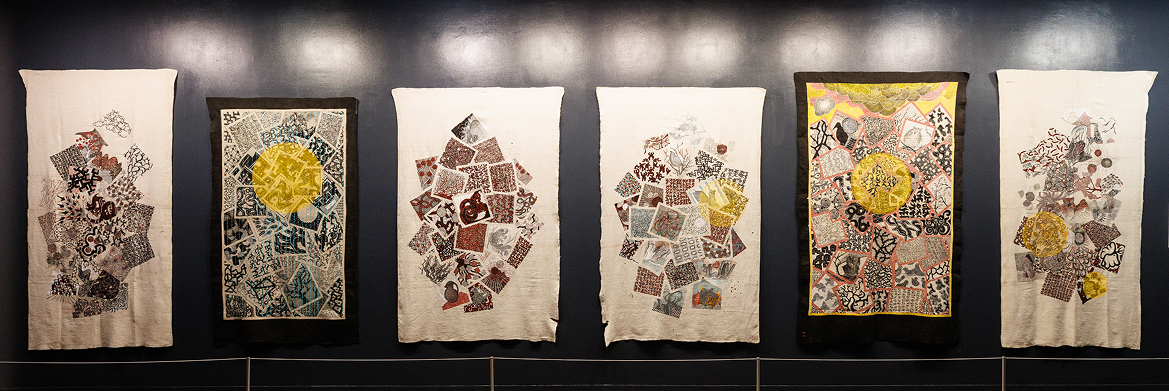
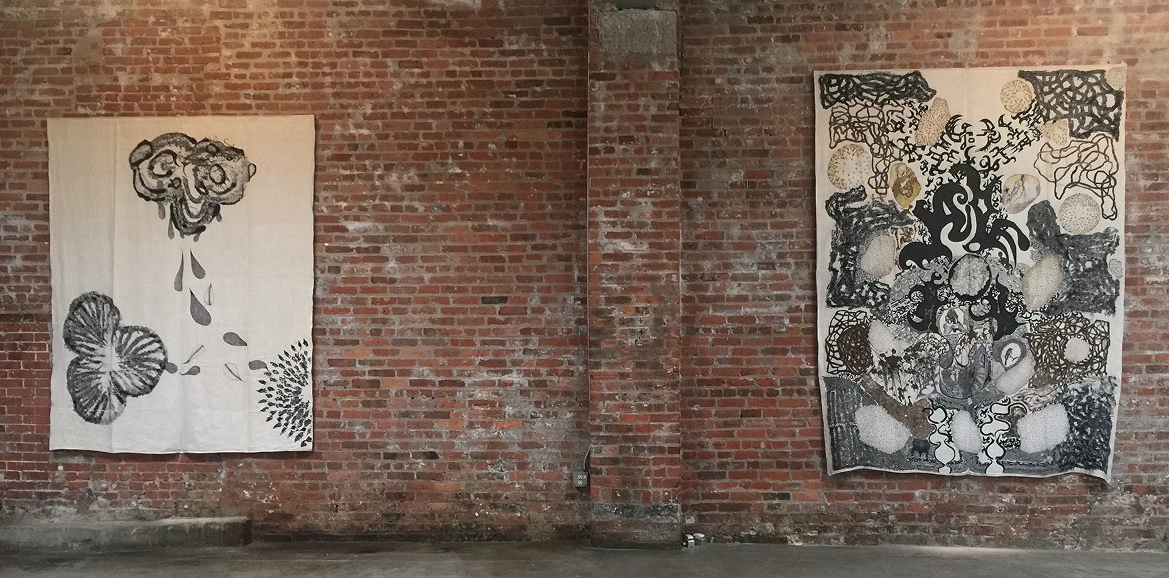
Bjorn Amelan’s art is to make one sonnet after another in Sumi ink and acrylic. Sonnets are the jewel boxes of lyric poetry and the most controlled of forms, with their fourteen lines and strict grids of stanzas, rhythmic patterns, and rhymes. Yet they are also the most expansive and varied of forms as their makers try to include and keep alive as much of the world as they can accumulate in these contained boxes, like children using a magnifying lens to focus sunlight to set a small square of paper on fire. Dante put the most beautiful women of Florence into his sonnets, as well as boat rides and hills turning white at the onset of winter. Shakespeare told stories across sonnets of a (made-up?) dark lady and a haughty young man, as well as kingdoms falling and the body stiffening with age. When a fellow artist first looked at Bjorn’s work, he asked, “What is your painting about?” “It’s about everything,” Bjorn answered. While this unrehearsed reply might feel like a glib adlib, it was also revealing. All his works are more encyclopedic than novelistic. Like sonnets, they can hold expanses and minutia at once. He had been making bronze and stone sculptures until he created the first of these paintings in 2008, using as his canvas hemp bedsheets — handwoven on farms in France — he and his husband, choreographer/director, Bill T. Jones sleep on to this day. “I liked using something directly in contact with the most intimate aspects of our life together,” he says. He also liked that their texture lent itself to Sumi ink painting, his preferred medium. Their unstretched, foldable surfaces let him work on a large scale while traveling through hotel rooms and rehearsal studios as Creative Director of New York Live Arts, the performance center of the Bill T. Jones/Arnie Zane Company. Given the fabric’s weight, density, and texture, the finished, uncoated works, when hung, were like vertical or horizontal tapestries.
Most of these early works were restricted in palette by the artist to black, white, and gray ink, and openly confessed a debt to Asian landscapes in evocations of nature as subtle as fingerprints. Since then, Bjorn’s work has fallen into periods, sequences, or phases. The most “literary” of these phases — he’s a bit of a “writer’s artist” — are long scrolls, or quilts of small squares of calligraphic invention, chain-link sentences made of exquisite shapes as abstract as the shapes of all letters and numbers when looked at with uncorrected vision. They imagine hieroglyphs, ideograms, or pictographs that Jorge Luis Borges might well have read in his dreams. Yet if these archaic alphabets are a code to be deciphered, the information they impart is simply — or crucially — the sensibility of the artist. Bjorn often worked, with brush, on these large-scale intricacies on eight-by-six-feet sizes of the bedsheets spread on the floor. In 2023, while he was working in Carson, New Mexico, color first appeared without warning in his moonlit works in the form of a sun-yellow pointillist circle that has hovered since and, like sunlight, exposed the color implicit in the works’ liminality. His sudden colors turn out to be the more subtle shades of true nature, not synthetic — raspberry not red, lilac instead of purple, calla lily white instead of blank white. The obsessions recur: starry skies straight out of a Joseph Cornell box; black-white sunflowers; stately ravens and an owl not in snow but made of snow; cartoon clouds. Yet in these new vertical works done on bedsheets cut in half, the postage stamps of imagery are shuffled and layered like decks of cards. With color comes depth and swirls of motion, variations not only of the stories, the stuff of dreams, but more jolting variations of structure, of the very foundation of the work, the subtext. They invite hypnagogic revery. They are luxuriant gardens of imagery yet also maps, as in mapping, as in mapping of the mind. But whose mind? His? Or ours? Looking into the mapped worlds of Bjorn Amelan, in these paintings, we see intimations of our own.
Brad Gooch